
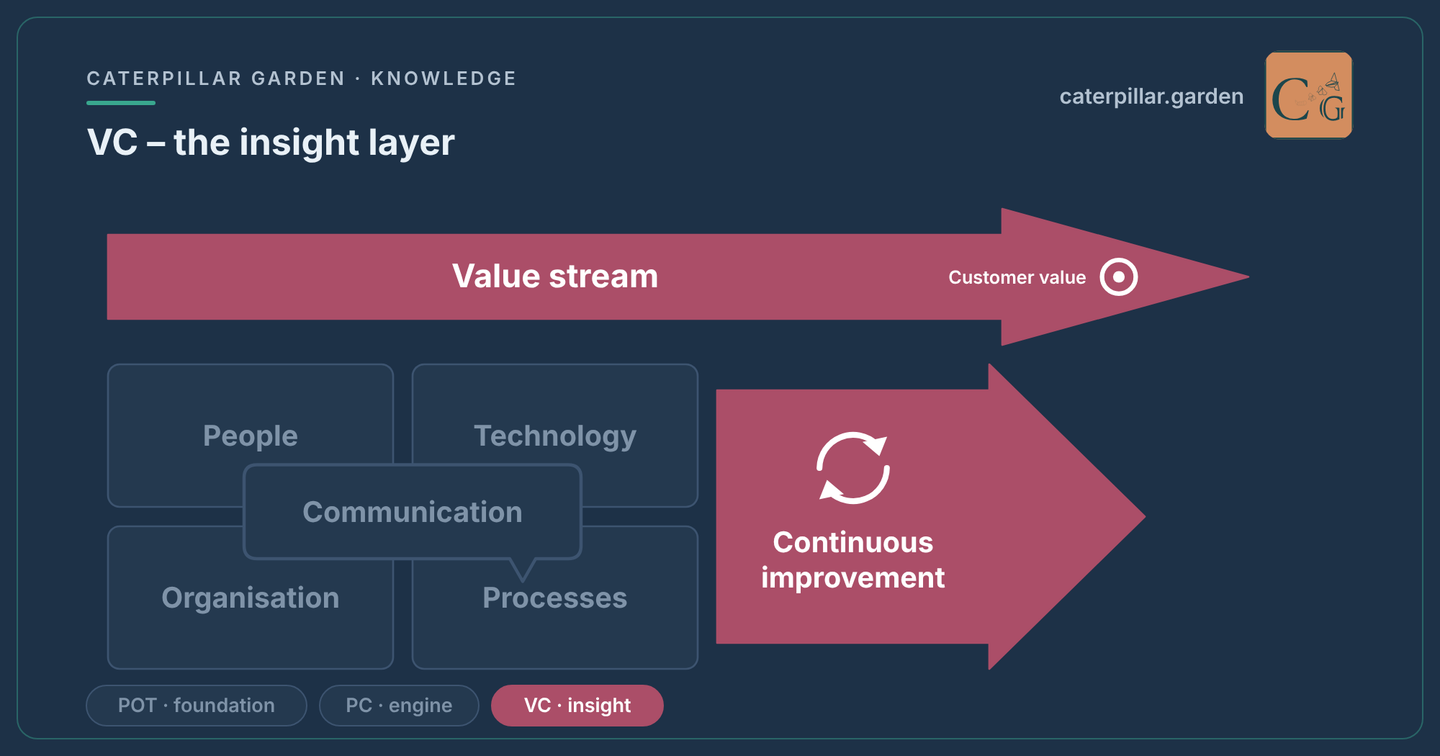
VC – Value Streams and Continuous Improvement – is the insight layer of the POT/PC/VC framework for IT operating models. It answers the question most operating models never ask: does this work still create value for the business – and are we getting better at delivering it?
This is the layer that makes POT/PC/VC different. In most frameworks continuous improvement is one box on the diagram. Here it is the roof that keeps rebuilding the house: a learning loop that checks the model on a rhythm and feeds what it finds back into the engine and the foundation.
Value streams
- End-to-end flow. The path from an idea to value in the customer's hands, mapped across team boundaries – with its bottlenecks, waiting times and handovers.
- Outcome and impact measurement. Flow metrics, waste made visible, and outcomes tied to business goals rather than to output.
- Customer focus. Knowing who the customer of each stream is, aligning the work with what they need, and validating it with them.
- Data-driven decisions. Data collected from the value streams and used in real decisions – not only in quarterly slides.
Continuous improvement
- Optimisation and automation. From understanding a process to automating it – lean first, automation second.
- External benchmarking. Comparing the model with market standards and research, and checking that the value proposition still holds.
- Feedback loop. Feedback with clear goals, used for improvement rather than collected for its own sake.
- OKRs and KPIs. Objectives and key results for operations, and a small set of KPIs that show the way to success.
- Definition of success. Success criteria that are validated with the business and adjusted when the context changes.
Signs the insight layer is missing
- "We reorganised last year – and nobody can say whether it helped."
- Flow from idea to production is not measured; only utilisation is.
- IT reports on tickets closed, the board asks about revenue and cost, and nobody translates between the two.
- Improvements happen by accident, after an incident, not on a rhythm.
The cheapest layer to start
The insight layer is often the one that is missing – and it is also the cheapest to begin with. It needs no new tool, only a decision about what is worth watching: one value stream, two flow measures, a review every month. Without it, you cannot tell whether any change in the other layers was worth the hours spent on it.
The Value-Flow Thinking Sprint maps one value stream with its system costs in a half-day workshop; the IT Operating Model Assessment scores the insight layer as two dimensions – value streams and flow, and continuous improvement and metrics.