
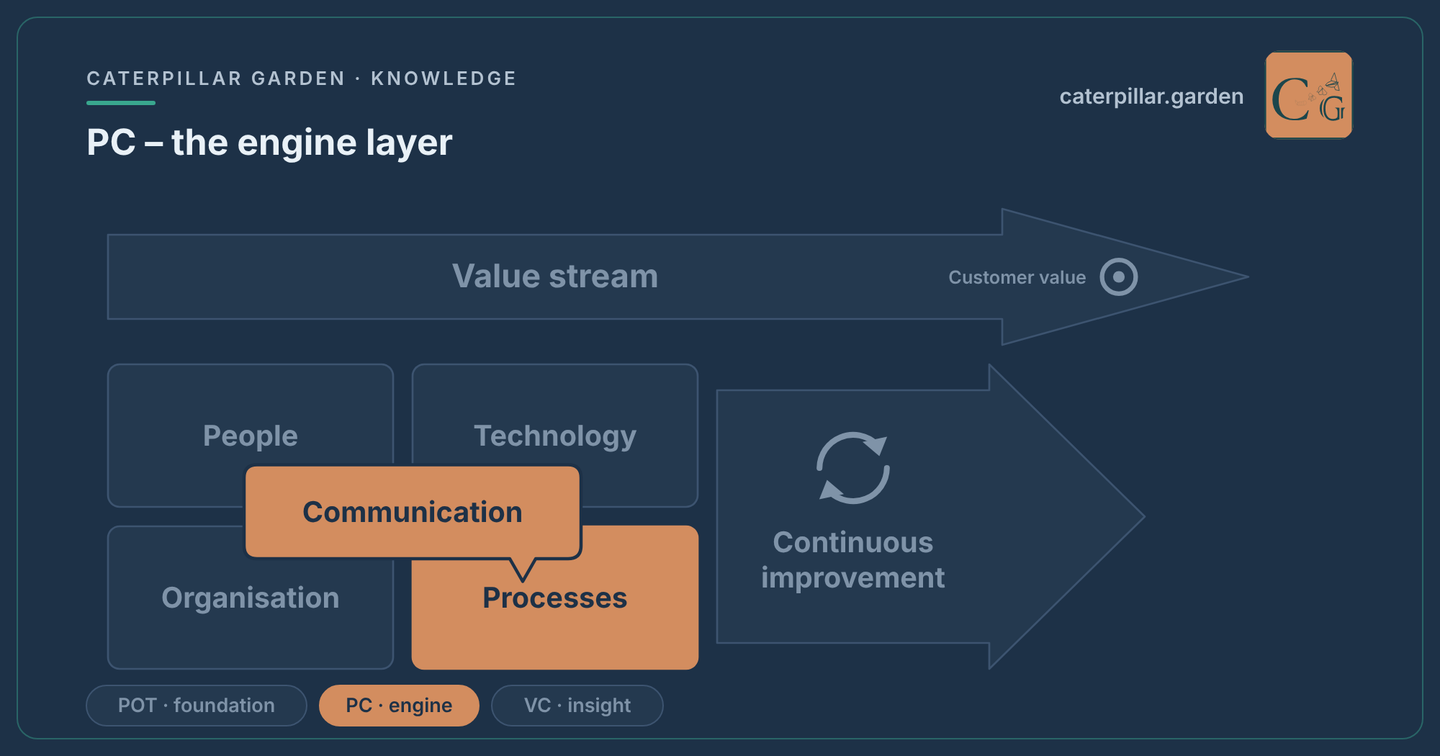
PC – Processes and Communication – is the engine layer of the POT/PC/VC framework for IT operating models. It turns the foundation – people, organisation and technology – into repeatable, quality work, and makes sure the right information reaches the right people when a decision is due.
A strong foundation with a weak engine produces activity, not results: busy teams, long queues and requests that pass five handovers before anyone starts.
Processes
- Agility. Lean and agile practices – iterative delivery, short feedback cycles, small batches – embedded in daily work, not added as ceremonies.
- Process mapping. A catalogue of the processes that matter, mapped end to end with their handovers and dependencies, then validated and simplified.
- Performance metrics and review. Process metrics such as cycle time and throughput, collected and reviewed on a fixed rhythm, and turned into improvements.
- Value-focused prioritisation. Work ranked by the value it brings and the cost of delay – for example with Weighted Shortest Job First (WSJF) and a cost-benefit view – rather than by who shouts loudest.
- Risk management. Risks identified early, accepted deliberately where innovation needs it, and mitigated where it does not.
- Change management. A clear change process, a change backlog, and the training people need to work in the new way.
Communication
- Stakeholder engagement. A RACI matrix, a stakeholder communication plan and regular updates, so the business is never surprised by IT.
- Decision-making. An explicit decision framework such as RAPID or DACI: who recommends, who decides, who must be consulted – and decisions recorded where people can find them.
- Cross-team collaboration. Shared goals, shared tools and a working rhythm that breaks silos between departments.
- Feedback. Structured ways to collect feedback, act on it and check whether acting on it helped.
Signs the engine is weak
- "Every request passes five handovers before anyone starts."
- Priorities change every week and nobody can say why.
- The same decision is taken three times in three meetings.
- Processes are described in documents nobody reads, while the real process lives in chat threads.
Where it leads
A running engine gives you something worth measuring. The top layer, VC – value streams and continuous improvement, checks whether this work still creates value and feeds what it learns back into the engine and the foundation. Before the engine, see POT – the foundation layer.