
Most IT operating models were never designed. They were inherited – from a previous CIO, a merger, a reorganisation that solved last year's problem. Teams, tools and processes pile up until nobody can say how a business request actually turns into working software, or whether the money spent on the way creates any value.
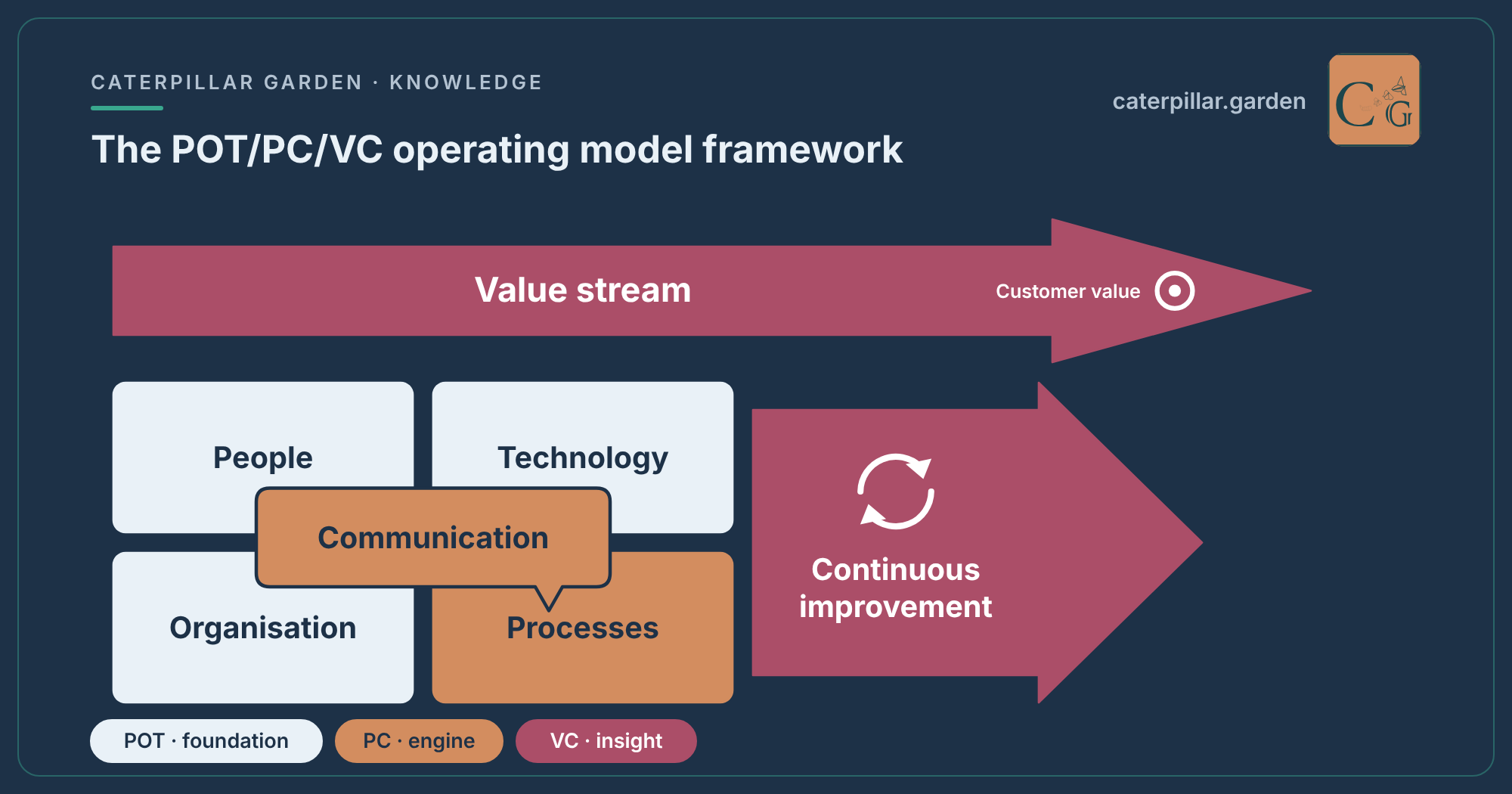
POT/PC/VC is the framework I use to assess and design IT operating models. It has three layers, and the order is the point.
What POT/PC/VC stands for
- POT – People, Organisation, Technology. The foundation: who does the work, how the work is arranged, and what it runs on.
- PC – Processes and Communication. The engine: how the work is actually performed and how information and decisions move between teams.
- VC – Value Streams and Continuous Improvement. The insight: what creates value for the business, how it flows to the customer, and how you know the model is getting better.
Why the order matters
The three layers are not three levels of bureaucracy. Each one is what makes the next one possible.
- Without the right people, a clear structure and a working platform (POT), no process will run well – it will run on heroes and workarounds.
- Without repeatable processes and clear communication (PC), the foundation produces activity, not results – and there is nothing stable enough to measure.
- Without the insight layer (VC), you cannot tell whether a change was worth the hours spent on it. The model freezes the day it is drawn.
So the framework is a build sequence: a foundation first, then an engine, then a learning loop on top that keeps checking whether the whole thing still creates value – and feeds what it learns back into the layers below. When something is wrong, I look for the place where this chain breaks. That is where the redesign starts.
What each layer covers
- POT – foundation. Do we have the right people, structure and technology, aligned and available? People development, mentorship and enablement, innovation culture, continuous learning, empowerment; vision and goals, roles and responsibilities, governance, knowledge; technology roadmap, integration, observability, automation, technical debt.
- PC – engine. Do those resources turn into repeatable, quality work? Agility, process mapping, performance metrics, value-focused prioritisation, risk management, change management; stakeholder engagement, decision-making, cross-team collaboration, feedback.
- VC – insight. Does the work still create value – and are we getting better at it? End-to-end flow, outcome and impact measurement, customer focus, data-driven decisions; optimisation and automation, external benchmarking, feedback loop, OKRs and KPIs, definition of success.
Each layer has its own article: POT – the foundation layer, PC – the engine layer and VC – the insight layer.
How I use it
In an IT Operating Model Assessment I score five dimensions that sit in the three layers – people and organisation, technology and platform, processes and communication, value streams and flow, continuous improvement and metrics. The result is not a long list of gaps. It is one redesign pathway: the first change worth making, where the chain breaks, with the effort it takes and the first three steps.
None of the layers has to be fixed at once. The insight layer is often the one that is missing, and it is also the cheapest to start: it needs no new tool, only a decision about what is worth watching. A typical first step is one value stream with its own team, a single intake and two flow measures – instead of five handovers between departments.
If the client wants it, the assessment is followed by operating model design with POT/PC/VC over four to six weeks, then value stream mapping and implementation.
What it gives the business
- Spend you can explain. IT cost is tied to value streams, not to departments – so the CFO can see what a euro buys.
- Faster delivery without more hiring. Fewer handovers and clearer decisions shorten the path from request to result.
- Changes you can check. Every redesign step has a measure, so a quarter later you know whether it worked.
- A model that stays true. The learning loop keeps the operating model aligned with the business as the market, the team and the technology change.
Why it matters more now
AI agents are entering operations, and they stress-test the operating model mercilessly: who owns a decision an agent prepares, which process it plugs into, how you know it helped. A model designed once and framed on a wall starts expiring the day it is printed. A model with a built-in learning loop adapts. I compare POT/PC/VC with McKinsey's 7S and the Operating Model Canvas in a separate article.
Frequently asked questions
What does POT/PC/VC stand for?
People, Organisation, Technology (POT); Processes and Communication (PC); Value Streams and Continuous Improvement (VC). They are the three layers of an IT operating model: foundation, engine and insight.
Is POT/PC/VC only for IT?
It was built for technology operating models – IT departments, engineering organisations, Centers of Excellence and platform teams. The same three layers work for any function that turns people and tools into a service for the rest of the business.
Does it replace frameworks like McKinsey 7S or the Operating Model Canvas?
Not necessarily. Those frameworks are good parts lists. POT/PC/VC adds what they leave out: the order in which to build, and a learning loop that keeps the model up to date.
Where should we start?
Where the chain breaks – and very often that is the insight layer, because without it nobody can tell whether the last reorganisation helped. If you would like to find out where yours breaks, book a conversation.