
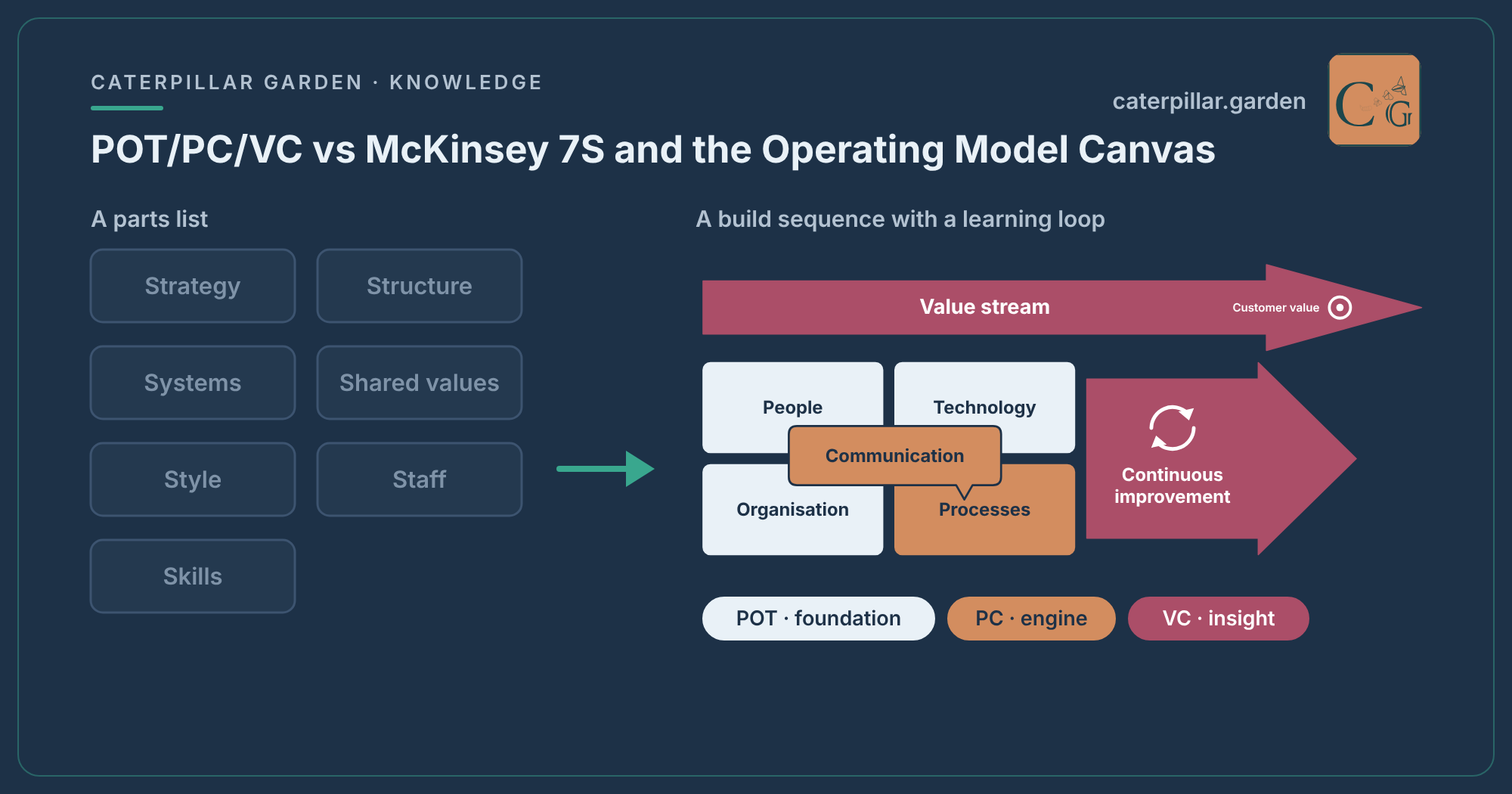
Operating model frameworks have been around for decades. McKinsey's 7S. The Operating Model Canvas with its POLISM lens – processes, organisation, locations, information, suppliers, management system. They are solid tools; I have used them. And they share one quiet assumption: that an operating model is a thing you design once, and then run.
A parts list is not a build sequence
Classic frameworks answer the question "which parts should an operating model have?" – and they answer it well. What they do not answer is in what order to build it, and what keeps it true a year later. A parts list is not a construction sequence, and it is certainly not a feedback loop.
That is why I shaped my own framework, POT/PC/VC. Three layers, and the order is the whole point:
- POT – People, Organisation, Technology – the foundation: the right people, structure and technology, aligned and available.
- PC – Processes and Communication – the engine: turning those resources into repeatable, quality work.
- VC – Value Streams and Continuous Improvement – the insight: checking whether the work still creates value, and feeding what we learn back into the layers below.
Side by side
- The main question. 7S: are seven elements of the organisation aligned? The Canvas: which parts deliver the value proposition? POT/PC/VC: in what order do we build the model, and how does it stay true?
- Structure. 7S: seven connected elements with shared values at the centre. The Canvas: six building blocks around the value chain. POT/PC/VC: three layers that depend on each other – foundation, engine, insight.
- Order of work. Not defined in 7S or the Canvas. In POT/PC/VC the foundation comes first, and a redesign starts where the chain breaks.
- Learning loop. Outside the model in 7S and the Canvas. Built in as the top layer (VC) in POT/PC/VC.
- Best used for. 7S: diagnosing misalignment. The Canvas: designing a target model on one page. POT/PC/VC: assessing, designing and continuously adjusting a technology operating model.
The frameworks are not rivals. 7S is a good lens for alignment and the Canvas a good one-page picture of a target model. POT/PC/VC can use both – it adds the sequence and the loop.
The difference is the third layer
In most frameworks "continuous improvement" is a box on the diagram. In POT/PC/VC it is the roof that keeps rebuilding the house. The model assumes from day one that it will soon be wrong, because the terrain shifts – quietly, all the time. Assumptions that were true when the model was drawn expire; the insight layer finds them on a rhythm instead of by accident.
Why this stopped being academic
Once you put AI agents into operations, they stress-test your operating model mercilessly. Who owns a decision an agent prepares? Which process does it plug into? How do you know it helped? A static snapshot, however elegant, starts expiring the day you print it. What you need is a model with a built-in learning loop.
Design your operating model like something you will maintain, not something you will frame on a wall. When was the last time yours learned something? If you are not sure, the IT Operating Model Assessment shows where the chain breaks – or book a conversation.